
Hand Print from Chauvet cave, 28,000 BCE http://www.robinurton.com/history/printmaking.htm

Swiss Playing Cards, woodblock print,1745 Relief Printing Relief printing involves printing from a raised surface. A simple example of this is a rubber stamp pressed into a stamp pad and pressed onto a piece of paper. Relief printing plates are made from flat sheets of material such as wood, linoleum, metal, styrofoam etc. Woodcut prints first appeared in the 8th century in the East and in the early 15th century in the West.
Relief Printing
Relief printing involves printing from a raised surface. A simple example of this is a rubber stamp pressed into a stamp pad and pressed onto a piece of paper. Relief printing plates are made from flat sheets of materials such as wood, linoleum, metal, styrofoam and lot more. Woodcut prints first appeared in the 8th century in the East and in the West during the early 15th century.
The Woodcut
The production involving Japanese woodblock prints is quite complex process, which is about having number of steps, each usually performed by a different person, who is skilled in particular step. Japanese prints were sometimes made in limited editions as "high art", however, often they were made in far larger editions as popular, mass-proudced art.

Japanese Ukiyo-e Print
Woodcut is about engraving on wood by hollowing out with chisels areas of a plank, leaving a design on the surface. The transfer of this design onto is achieved by linking the surface with typographic ink and either applying pressure by rolling the relief plate and paper onto a press, or rubbing the back of the paper with a baren which is a Japanese method.
Wood Engraving
With a traditional woodcut, the design is drawn directly onto the wood which is cut along the length of the grain or tree trunk. But the wood has a tendency to splinter. Artists have found out that they could resolved this problem by cutting on the end grain of the hardwood blocks, a process called wood engraving. By using a burin, which is a metal tool can can as well be use in metal engraving, the wood engraver could produce a wider range of tones than were possible with a woodcut.
Linocut Printmaking
Linocut is a printmaking technique same to woodcut, the difference is that the image is engraved on linoleum instead of wood. As linoleum offers an easier surface for working, linocuts offer more precision and a greater variety of effects than woodcuts. Linocut came into its own after artists like Picasso and Matisse began work in that technique.
Intaglio Printing
Intaglio printing describe a process whereby an image or picture which is cut into the surface of the printing plate. The areas that are cut away, will have ink which will be pushed into them. The cut lines are what will be print on the paper. The simplest intaglio process is the drypoint. A sharp-pointd tool like dentist's tool is directly drawn onto the surface of the metal plate. The displaced metal creates a "blur" which catches the ink.

The most common form of intaglio printing is the engraving. Using a sharp v-shape tool called a burin, the printmaker gouges the lines of an picture into the surface of a smooth polished sheet of metal. When ink is pushed into the lines it can be wiped clean with tissue, nets and other things so that only that will retain the ink are the cut lines. A sheet of paper which had been soaked in the water is then placed on the plate which is run through a printing press. The paper will be forced into the small lines that have been cut into the plate.
Etching is a variation of the engraving technique. With etching , acids are used to eat into the metal plate. It produces a softer effect than engraving, producing more subtle gradations of tone.
Aquatint
This technique finished prints that always look like watercolours or wash drawings. It can produce a wide range of tonal values.The technique involves exposing the plate to acid through a layer or sometimes successive layers or resin or sugar. The acid bites the plate only in the spaces between the resin particles, achieving a finely and evenly pitted surface that yields broad areas of tone when the grains are washed off and the plate is inked and printed. A lot of different tones can be achieved on a single plate by exposing different areas to various acid concentration or different exposure times. This technique can be used with etching or engraving to achieve linear definition. The plate is then bitten in the acid bath and the resulting print has a soft, painterly
look.


look.
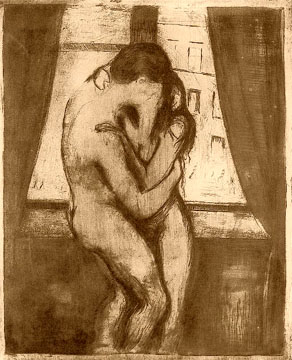
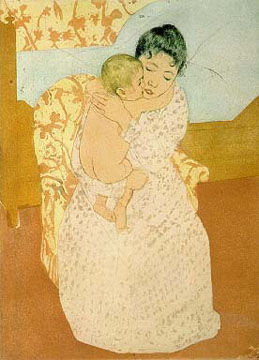
Mary Cassatt: Mother and Child Edvard Munch: The Kiss
Monoprints
Monoprint is achieved by putting coloured inks to a smooth surface and then transferring that image on a paper. The earliest mono-print date back to the 1660's. Famous artists like: Gaugin, Rembrandt and Degas experimented with mono-print techniques. Mono-print is a spontaneous art form which can also be use with mixed media techniques.
Suzy Olsen specialises in creating watercolour monoprints. She paints the image onto the plexiglass panel, then runs the dampened paper through the press, transferring the watercolour to to the sheet. This requires several re-workings of the image, adding different colours to successive layers.
Lithography
Screen-Printing
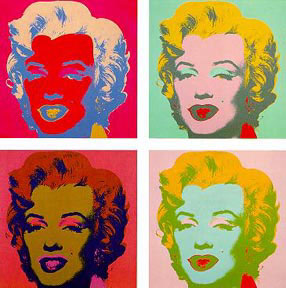
Silk screen which is also called "serigraphy" came from China and found its way to the West in the 15th century. It is a stencil process based on open weave of silk or nylon which allows ink to pass through the areas which not stopped with glue, or plastic stencils. One or more layers of ink are put with a squegee, each one covering the open areas of line and halftone, can also be fixed composite picture achieved. Photographic transfers, both in line and halftone, can also be fixed to the screen with a light-sensitive emulsion.
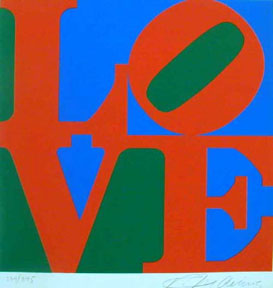
Robert Indiana, Love 1967
Andy Warhol Marilyn 1967

No comments:
Post a Comment